Beyond Vibe Coding: Why AI Architecture is the New Senior Dev Skill in 2026
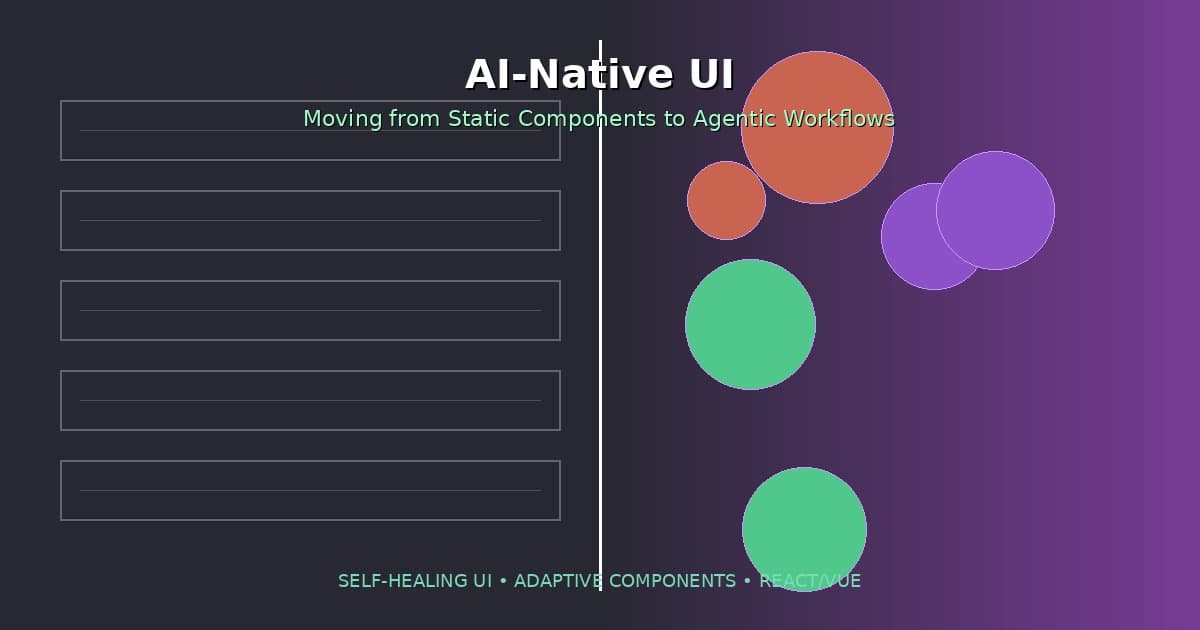
Beyond Vibe Coding: Why AI Architecture is the New Senior Dev Skill in 2026
In 2024-25, we were all excited about "Vibe Coding" — generating code from natural language prompts. But in 2026, the game has fundamentally changed. Writing code isn't the differentiator anymore. Designing how that code works together is the real skill.
The Vibe Coding Trap
Let's be honest: AI can now write code with 99% syntactic accuracy. Pass it a prompt, get working code. It handles the syntax, the boilerplate, the edge cases you'd forget.
But here's the trap: syntax is not engineering.
Junior developers who learned to "prompt their way to a working app" are hitting a wall. Their code works in isolation but falls apart at scale. No error boundaries. No graceful degradation. No coherent architecture.
That's where AI Architecture comes in.
What is AI Architecture?
AI Architecture is the skill of designing constraints, boundaries, and orchestration for AI-generated code. It's knowing:
- Which components should talk to each other (and which shouldn't)
- Where to place error boundaries and fallback logic
- How to decompose a complex system into AI-manageable chunks
- When to let AI decide and when to enforce human oversight
Think of it as the difference between:
- Vibe Coder: "Build me a login system"
- AI Architect: "Build a login system with these constraints: rate limiting at 5 attempts, JWT with 15-min expiry, refresh token rotation, and audit logging for every auth event"
Same task. Vastly different outcomes.
Key Insights for 2026
1. The Syntax Trap
AI writes syntax. You design semantics. Memorizing framework APIs is no longer a competitive advantage — understanding why and when to use them is.
2. Architecting Constraints is the New Coding
A senior developer's job is now about giving AI the right boundaries:
- Business logic constraints
- Data flow boundaries
- Performance budgets
- Security policies
The AI fills in the implementation. You define the rules.
3. System Design over Snippets
The real challenge isn't generating a function — it's organizing multiple AI agents, each producing parts of a larger system, so they work together coherently.
This requires:
- Interface contracts between modules
- Event-driven communication patterns
- Shared state management strategies
- Testing at integration boundaries
Practical Example: Multi-Agent Orchestration
In my own setup, I manage a team of 8+ AI agents (Friday Force) for full-stack development. The hardest part isn't getting any single agent to write code — it's orchestrating them so their outputs merge cleanly.
# Simplified orchestration pattern
task: "Add licence renewal feature"
workflow:
  - agent: backend-dev
    action: "Create LicenceRenewalService"
    constraints:
      - Must use existing PaymentService
      - Renewal extends expiry by licence duration
      - Fire LicenceRenewed event
      - Write PHPUnit tests (90% coverage)

  - agent: frontend-dev
    action: "Build renewal UI in React"
    depends_on: [backend-dev]
    constraints:
      - Use existing licence table component
      - Add confirmation modal before renewal
      - Show renewal date in user's timezone

  - agent: qa-agent
    action: "Review PR and run test suite"
    depends_on: [backend-dev, frontend-dev]
Each agent produces a piece. The architecture ensures they fit together.
The Skill Gap
Here's what separates AI Architects from Vibe Coders:
| Skill | Vibe Coder | AI Architect |
| Code generation | Prompt → Code | Constraints → Code |
| Debugging | Trial and error | Systematic isolation |
| Architecture | Copy-paste patterns | Domain-driven design |
| Testing | "Does it work?" | Boundary + integration tests |
| Scale | "It works on my machine" | Performance budgets + monitoring |
How to Level Up
- Study system design — not just algorithms, but real-world distributed systems
- Learn constraint specification — practice writing precise requirements that AI can follow
- Build with multiple agents — understand orchestration, not just prompting
- Focus on integration testing — the seams between AI-generated modules are where bugs hide
- Read production postmortems — learn how real systems fail
The Bottom Line
Those who only prompt their way to working code are now "Junior Vibe Coders." Those who understand system design and orchestration are the real AI Architects — and that's the most valuable developer skill in 2026.
Don't just write code. Design systems.